



A mobile containerized water treatment plant can restore drinking-water production quickly where permanent infrastructure is unavailable or damaged. This guide explains the source-water, capacity, autonomy and maintenance information required to select a system for emergency, humanitarian or infrastructure projects.
What is a mobile containerized water treatment plant?
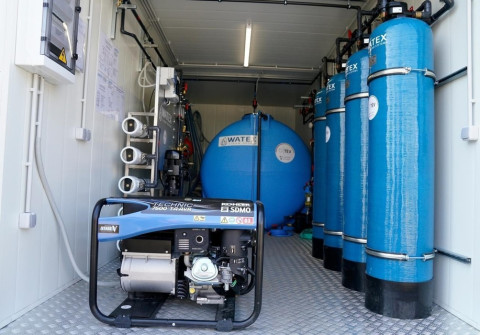
A containerized water treatment plant is a factory-assembled system that combines raw-water intake, pre-treatment, primary purification, clean-water storage and distribution. Installation inside a standard ISO container simplifies international transport and protects the equipment during demanding field operation.
1. Start with a raw-water analysis
The correct treatment process depends on whether the source is a river, lake, pond, canal, borehole or brackish water. A laboratory analysis should cover at least turbidity, salinity, organic matter, iron and manganese, and microbiological indicators. The results determine the need for pre-filtration, activated carbon, reverse osmosis, UV disinfection and chemical dosing.
2. Calculate the required drinking-water capacity
Do not select capacity from population alone. Consider drinking and cooking demand, operating hours per day, clean-water storage, peak distribution and the possible reduction in output caused by difficult raw water. For example, the WATEX MWTP2000 mobile containerized water treatment plant has a nominal production capacity of up to 2,000 L/h and a 5,000 L clean-water tank.
3. Check autonomous operation and deployment requirements
An emergency water system should remain usable where grid electricity is unreliable. Review generator capacity and fuel supply, raw-water pump installation, pipe connections, concentrate or wastewater discharge and the time required for a trained crew to start production.
4. Plan maintenance and consumables
Long-term operation requires replacement filters, membranes, activated-carbon media, UV lamps, antiscalant and generator maintenance materials. Ask the supplier for a project-specific spare-parts package, maintenance schedule, operating manual and personnel training.
5. Confirm the destination-country drinking-water standard
For an international project, the treated water must meet the destination country’s or client’s applicable drinking-water requirements. Include the project country and site, source-water analysis, required daily volume, operating environment, delivery schedule and required final-water standard in the technical enquiry.
When should you choose WATEX MWTP2000?
MWTP2000 is intended for municipalities, civil-protection and emergency-response teams, humanitarian organisations, infrastructure contractors and operators of temporary or remote facilities. It combines multi-stage filtration, activated carbon and reverse osmosis inside a transportable 20-foot ISO container.
View the MWTP2000 specifications and request an international project quotation.

 This is a good choice!